Industrial Fasteners


Coupling Nut
Coupling Nut for Threaded Assemblies
The Coupling Nut is a threaded fastening element used to join or secure mating components in assemblies. It is selected where a secure threaded connection is required, often in combination with studs, fittings, or special mating hardware. Procurement teams specify coupling nuts by thread, length, and head style.
Manufacturing and Fit
Production focuses on thread form accuracy, material choice, and head geometry to ensure reliable engagement and torque response. Dimensional inspection validates thread profile and length to ensure compliance with mating parts.
Supply and Commercial Notes
Available for bulk sourcing with repeat production options. Protective packaging and batch inspection reports support production and maintenance programs.
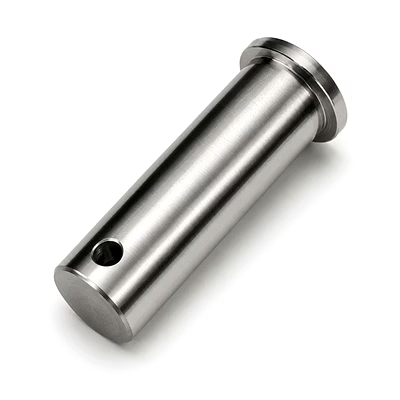
Clevis Pin
Clevis Pin for Pivot and Linkage Connections
The Clevis Pin is a cylindrical fastener used to form removable pivot joints and linkages. It is commonly employed in mechanical linkages, clevis assemblies, and hinged connections where secure retention and easy disassembly are required. Procurement teams select clevis pins by diameter, length, and retention method.
Manufacture and Fit
Production emphasizes dimensional straightness, shoulder geometry, and finish to ensure smooth pivoting and consistent retention. Inspection validates overall length, diameter, and surface condition to ensure compatibility with mating clevis components.
Supply and Ordering
Available for bulk sourcing and scheduled production runs. Protective packaging secures pins to avoid surface damage during transit. Buyers should specify retention style and any coating requirements when ordering.

Grub Screw
Threaded Grub Screw for Secure Fastening Applications
Dimensional Precision and Material Specs
The grub screw is a headless set screw intended to lock components on shafts or within assemblies. It provides localized clamping without projecting heads. Selection focuses on thread standard, material grade, and tip style to suit the mating component and prevent fretting or loosening in service.
Procurement and Volume Supply
Bulk production and packaging options are available. Inspection and material documentation support procurement acceptance criteria.
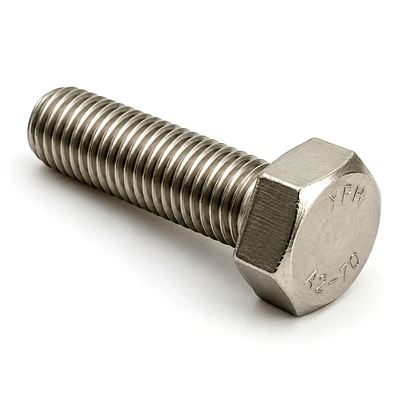
Non Standard Fastners
Non Standard Fastners for Custom Assemblies
Non Standard Fastners covers specially configured fasteners produced to non-catalog dimensions or unique functional profiles. These fasteners are specified when off-the-shelf parts do not meet assembly geometry, retention, or interface requirements. Procurement teams use this SKU type for build-to-print and custom integration projects.
Material and Dimensional Considerations
Selection focuses on the mechanical role of the fastener, including thread form, shank profile, and head geometry. Production emphasizes dimensional control, thread quality, and fit for mating components. Surface finish and coating choices depend on corrosion and assembly conditions.
Procurement & Production Support
Custom production runs support prototype-to-production transitions. Commercial volume procurement is supported for recurring programs. Buyers should supply drawings and targeted volume bands to align production planning and inspection sampling.

Studs
Threaded Studs for Mechanical Fastening and Assembly
Process, Tolerance, and Interface Fit
Threaded studs provide a double-ended threaded fastening solution for flanged joints and assemblies requiring bolted connections. They offer consistent clamping and can be specified with various thread classes, lengths, and material grades to match assembly torque and corrosion requirements.
Procurement and Production Support
Production accommodates prototype and production volumes with inspection and material traceability. Packaging safeguards threads and prevents damage during transit.
Industrial Fasteners are precision-engineered components used to securely assemble mechanical systems across hydraulic, automotive, industrial machinery and engineering applications. Manufactured to meet demanding performance requirements, these components provide reliable fastening, structural integrity and repeatable assembly in OEM equipment and custom engineering projects. Buyers typically evaluate Industrial Fasteners based on material, thread specifications, dimensional accuracy and application requirements.
Selecting the right Industrial Fasteners Manufacturer is essential for consistent product quality and dependable supply. Providing engineering drawings, material grades, thread specifications and production volumes in the RFQ enables manufacturers to recommend suitable OEM Industrial Fasteners and Custom Industrial Fasteners for long-term production requirements.
Industrial Fasteners for OEM & Engineering Applications
Industrial Fasteners are widely used in hydraulic systems, automotive assemblies, industrial equipment and engineering machinery where secure fastening and dimensional consistency are critical. Engineering Fasteners, Threaded Fasteners and Hydraulic Fasteners are manufactured to meet application-specific performance requirements while supporting reliable assembly, maintenance and service life across demanding operating environments.
Custom Manufacturing & Precision Fasteners
Precision Industrial Fasteners are manufactured according to customer drawings, thread specifications and functional requirements. Manufacturing capabilities include CNC Machined Fasteners, Non Standard Fasteners and Build-to-Print Industrial Fasteners produced with controlled machining processes and quality inspections. Components such as Threaded Studs, Grub Screws, Clevis Pins, Coupling Nuts and Banjo Bolts can be manufactured to meet OEM and application-specific requirements.
OEM Supply & Quality Assurance
OEM Industrial Fasteners are manufactured with emphasis on dimensional accuracy, batch consistency and product traceability. Sharing engineering drawings, inspection requirements, material specifications and annual production volumes enables efficient manufacturing, quality control and dependable supply for industrial and OEM applications. Material certifications and inspection documentation can be provided based on project requirements.
FAQs
Can Industrial Fasteners be manufactured to custom drawings? Yes. Custom Industrial Fasteners can be manufactured according to customer drawings, material specifications, thread requirements and dimensional tolerances for OEM and engineering applications.
Which industries use Precision Industrial Fasteners? Precision Industrial Fasteners are widely used in hydraulic equipment, automotive systems, industrial machinery, engineering assemblies and other applications requiring reliable fastening and consistent dimensional accuracy.
What information should be included in an RFQ for Industrial Fasteners? Include engineering drawings, material grade, thread specifications, dimensions, required quantities, inspection requirements and any certification or testing requirements to receive accurate technical recommendations and commercial quotations.
What should buyers consider when selecting an Industrial Fasteners Manufacturer? Evaluate manufacturing capability, machining accuracy, quality assurance processes, material expertise, production capacity and experience in supplying OEM Industrial Fasteners for similar industrial applications.